 Image 1 of 2
 Image 2 of 2
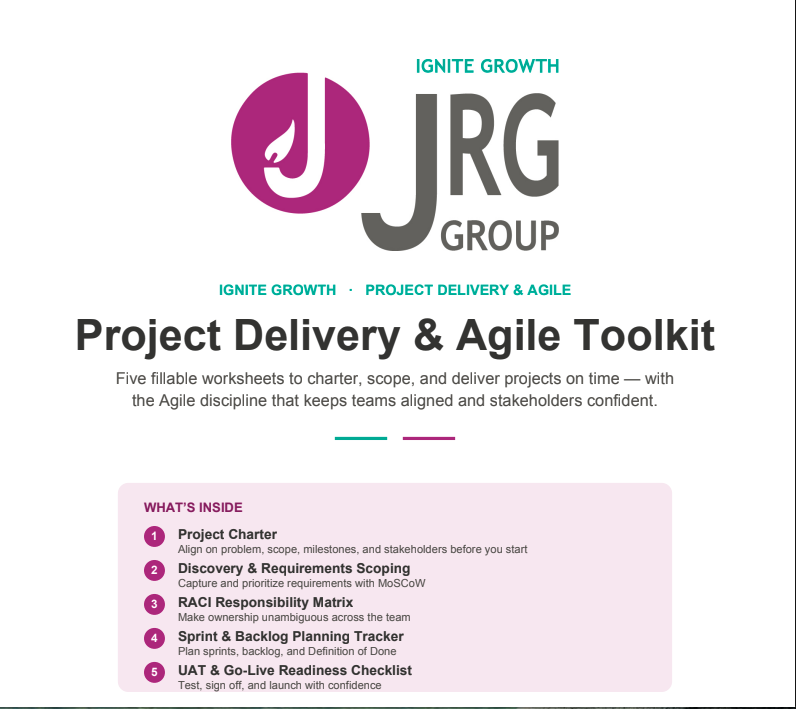
The Project Delivery & Agile Toolkit — a fillable resource from The JRG Group — helps project managers, founders, and operations teams run software, CRM, and process projects with structure, clarity, and a little bit of quirky wisdom. Use it as a flexible framework: each interactive field adapts to your organization’s processes, team size, and delivery cadence.
What’s inside (five core worksheets)
Project Charter
Purpose: One-page alignment tool to get stakeholders on the same page before work starts.
Key fields: Project name, sponsor, owner, problem statement, objectives, success criteria (measurable), scope in/out, major milestones, budget/constraints, key risks, stakeholders & escalation path.
Use it to: Stop scope creep before it starts, get executive sign-off, and provide a single-page reference for kickoff and governance.
Discovery & Requirements Scoping (MoSCoW)
Purpose: Prioritize features and requirements so the team builds the most important things first.
Structure: Requirement description, acceptance criteria, MoSCoW category (Must / Should / Could / Won’t), estimated effort, related risks/assumptions, dependencies, stakeholder owner.
Use it to: Drive meaningful backlog conversations, make trade-offs visible, and create a prioritized intake that survives reality.
RACI Responsibility Matrix
Purpose: Define ownership and reduce role confusion across activities and deliverables.
Structure: Activities/deliverables listed in rows; team roles in columns. Mark each cell with R (Responsible), A (Accountable), C (Consulted), I (Informed).
Best practices: Keep one A per deliverable, limit R’s to those doing the work, document decision rights for escalations, and review the matrix at each phase gate.
Use it to: Speed decisions, avoid duplicated work, and clarify who gets invited to which meetings.
Sprint & Backlog Planning Tracker
Purpose: Plan sprints, estimate backlog items, and lock down a shared Definition of Done (DoD).
Structure: Backlog item, priority, story points/estimate, sprint assignment, acceptance criteria, DoD checklist (unit tests, code review, documentation, config completed), dependencies, owner, status.
Tips: Timebox sprint planning, use historical velocity for forecasting, and capture sprint goals (not just ticket lists).
Use it to: Keep iterations predictable, make progress visible, and help product owners make informed release decisions.
UAT & Go-Live Readiness Checklist
Purpose: Final validation before launch to confirm quality, documentation, and operational readiness.
Sections: Functional validation (UAT sign-off), regression checks, performance/security baseline, configuration & data migration verification, user documentation & training completed, support & escalation procedures in place, deployment runbook, rollback plan, legal/compliance sign-offs, stakeholder approval for go/no-go.
Use it to: Reduce post-launch surprises, ensure handoff to operations/support is clean, and enable confident launch decisions.
How to use the toolkit
Start with the Project Charter to lock alignment, then run Discovery & Requirements to feed the backlog. Use the RACI to clarify who does what. Manage delivery through the Sprint & Backlog Planning Tracker. Finish with UAT & Go-Live Readiness to validate and launch.
Keep it iterative: revisit the charter, reprioritize MoSCoW items, and update the RACI as the team or scope changes.
Customize: fields are intentionally flexible—add company-specific compliance items, tweak DoD criteria, or expand sprint tracking to include release trains.
Why it works
Focused: One-page charter + prioritized requirements = less upfront noise.
Accountable: RACI enforces clarity so tasks don’t become “someone’s problem.”
Repeatable: Sprint tracker + DoD standardize delivery quality.
Safe: UAT checklist and runbook reduce launch risk.
Want a quick starter workflow
Day 0: Complete Project Charter and get sponsor sign-off.
Discovery week(s): Run workshops, populate MoSCoW sheet, draft backlog.
Pre-sprint: Build RACI, estimate backlog, set sprint goals.
Iterations: Use Sprint Tracker each sprint; update velocity and priorities.
Pre-launch: Run UAT checklist, rehearsal deployment, finalize runbook, decision meeting for go/no-go.
The JRG Group built this toolkit to be practical, adaptable, and slightly unapologetic about getting projects done. Fill it, bend it to fit your reality, and deliver with confidence (and maybe a tiny victory dance at launch).
The Project Delivery & Agile Toolkit — a fillable resource from The JRG Group — helps project managers, founders, and operations teams run software, CRM, and process projects with structure, clarity, and a little bit of quirky wisdom. Use it as a flexible framework: each interactive field adapts to your organization’s processes, team size, and delivery cadence.
What’s inside (five core worksheets)
Project Charter
Purpose: One-page alignment tool to get stakeholders on the same page before work starts.
Key fields: Project name, sponsor, owner, problem statement, objectives, success criteria (measurable), scope in/out, major milestones, budget/constraints, key risks, stakeholders & escalation path.
Use it to: Stop scope creep before it starts, get executive sign-off, and provide a single-page reference for kickoff and governance.
Discovery & Requirements Scoping (MoSCoW)
Purpose: Prioritize features and requirements so the team builds the most important things first.
Structure: Requirement description, acceptance criteria, MoSCoW category (Must / Should / Could / Won’t), estimated effort, related risks/assumptions, dependencies, stakeholder owner.
Use it to: Drive meaningful backlog conversations, make trade-offs visible, and create a prioritized intake that survives reality.
RACI Responsibility Matrix
Purpose: Define ownership and reduce role confusion across activities and deliverables.
Structure: Activities/deliverables listed in rows; team roles in columns. Mark each cell with R (Responsible), A (Accountable), C (Consulted), I (Informed).
Best practices: Keep one A per deliverable, limit R’s to those doing the work, document decision rights for escalations, and review the matrix at each phase gate.
Use it to: Speed decisions, avoid duplicated work, and clarify who gets invited to which meetings.
Sprint & Backlog Planning Tracker
Purpose: Plan sprints, estimate backlog items, and lock down a shared Definition of Done (DoD).
Structure: Backlog item, priority, story points/estimate, sprint assignment, acceptance criteria, DoD checklist (unit tests, code review, documentation, config completed), dependencies, owner, status.
Tips: Timebox sprint planning, use historical velocity for forecasting, and capture sprint goals (not just ticket lists).
Use it to: Keep iterations predictable, make progress visible, and help product owners make informed release decisions.
UAT & Go-Live Readiness Checklist
Purpose: Final validation before launch to confirm quality, documentation, and operational readiness.
Sections: Functional validation (UAT sign-off), regression checks, performance/security baseline, configuration & data migration verification, user documentation & training completed, support & escalation procedures in place, deployment runbook, rollback plan, legal/compliance sign-offs, stakeholder approval for go/no-go.
Use it to: Reduce post-launch surprises, ensure handoff to operations/support is clean, and enable confident launch decisions.
How to use the toolkit
Start with the Project Charter to lock alignment, then run Discovery & Requirements to feed the backlog. Use the RACI to clarify who does what. Manage delivery through the Sprint & Backlog Planning Tracker. Finish with UAT & Go-Live Readiness to validate and launch.
Keep it iterative: revisit the charter, reprioritize MoSCoW items, and update the RACI as the team or scope changes.
Customize: fields are intentionally flexible—add company-specific compliance items, tweak DoD criteria, or expand sprint tracking to include release trains.
Why it works
Focused: One-page charter + prioritized requirements = less upfront noise.
Accountable: RACI enforces clarity so tasks don’t become “someone’s problem.”
Repeatable: Sprint tracker + DoD standardize delivery quality.
Safe: UAT checklist and runbook reduce launch risk.
Want a quick starter workflow
Day 0: Complete Project Charter and get sponsor sign-off.
Discovery week(s): Run workshops, populate MoSCoW sheet, draft backlog.
Pre-sprint: Build RACI, estimate backlog, set sprint goals.
Iterations: Use Sprint Tracker each sprint; update velocity and priorities.
Pre-launch: Run UAT checklist, rehearsal deployment, finalize runbook, decision meeting for go/no-go.
The JRG Group built this toolkit to be practical, adaptable, and slightly unapologetic about getting projects done. Fill it, bend it to fit your reality, and deliver with confidence (and maybe a tiny victory dance at launch).