 Image 1 of 2
 Image 2 of 2
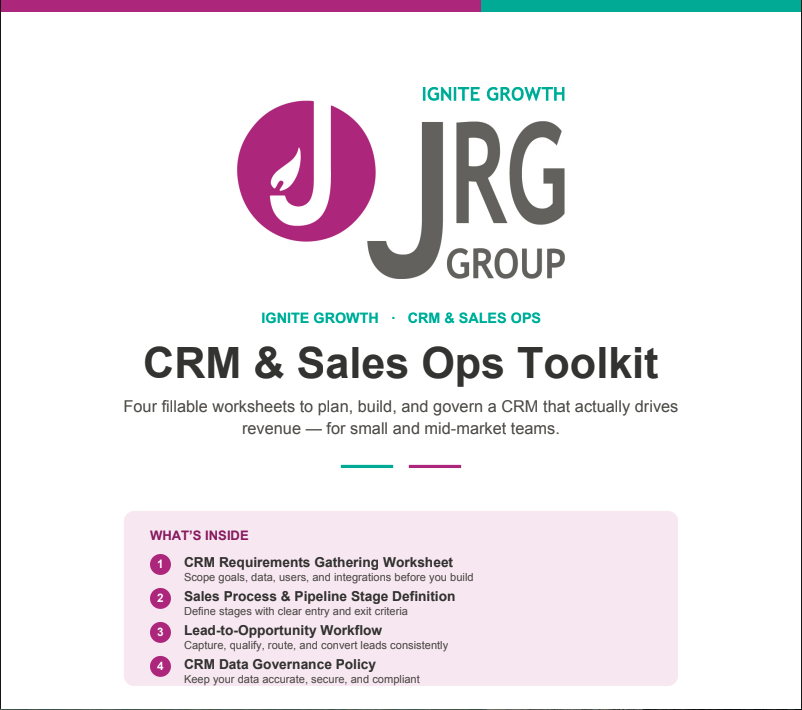
This toolkit helps founders, sales/revenue leaders, and operations teams at small and mid-market companies plan, clean up, or structure their CRM so it actually works for your business instead of being a dusty contact graveyard. It walks teams through decision-making before you build or rebuild, reduces ambiguity during implementation, and creates repeatable processes for ongoing CRM health.
Designed for:
Founders and executive leaders who need CRM strategy aligned to business objectives.
Sales and revenue leaders who own pipeline, forecasting, and quota attainment.
Operations, RevOps, and GTM enablement teams responsible for systems, processes, and day‑to‑day CRM hygiene. Use this if you’re planning a new CRM, migrating data, tightening pipeline discipline, or just trying to stop duplicate records from multiplying like rabbits.
The toolkit contains four fillable worksheets, to be completed in sequence. Each worksheet uses plain business language and practical prompts so you can make decisions fast and hand a clean brief to an admin, consultant, or implementation partner.
Purpose: Capture the business context and constraints before any configuration or customization begins.
Key sections to complete:
Company snapshot: legal entity, primary go-to-market motions, product lines, and key revenue streams.
Business objectives: top 3–5 goals the CRM must support (e.g., shorten sales cycle by 20%, improve renewal rate, enable multi-product quoting).
Success metrics: how you’ll measure impact (e.g., ARR, pipeline coverage, lead-to-opportunity conversion, sales velocity).
Current-state processes & pain points: brief descriptions of how sales, service, and marketing currently operate in the CRM and what’s broken.
Intended users & permission considerations: who needs access and at what level (sales reps, managers, CS, marketing, finance).
Record types to manage: accounts, contacts, leads, opportunities, cases, subscriptions, contracts, custom objects.
Sales/service snapshots: typical deal sizes, sales motions (inside vs. field), renewal cadence, support SLAs.
Integrations: systems that must connect (billing, marketing automation, product telemetry, analytics, support).
Constraints: budget, timeline, regulatory or security requirements, and resource availability.
Outcome: A prioritized, business-aligned list of CRM requirements that guides configuration choices, integration scope, and resourcing.
Purpose: Standardize pipeline stages and rules so forecasting and reporting are reliable across reps and teams.
Key sections to complete:
Sales motions and stage mapping: map each go-to-market motion to a linear set of pipeline stages.
Stage definitions: for every stage include:
Clear entry criteria (what conditions move a record into the stage)
Exit criteria (what must be true to move it forward)
Minimum required fields and record data
Forecast probability (percentage used for weighted forecasting)
Typical duration or time-in-stage expectations
Closed-lost and disqualification taxonomy:
Standardize reasons (pricing, product fit, timing, competitor, budget, no contact, duplicate)
Capture who is responsible for recording reason and any follow-up steps (e.g., nurture, archive)
Stage ownership and handoffs: who owns deals in each stage (AE, SDR, Channel, Partner)
Reporting hooks: required fields or flags for forecasting, cohort analysis, and win/loss reporting
Outcome: A documented pipeline framework you can configure in CRM and train teams on, reducing ambiguity and improving forecast accuracy.
Purpose: Define how inbound and outbound leads flow into the CRM, how they’re qualified, scored, and when they become opportunities.
Key sections to complete:
Lead sources inventory: list all sources (web forms, events, SDR, partners, marketing campaigns, paid ads) and capture ingestion methods.
Lead capture rules: required fields, deduplication checks
This toolkit helps founders, sales/revenue leaders, and operations teams at small and mid-market companies plan, clean up, or structure their CRM so it actually works for your business instead of being a dusty contact graveyard. It walks teams through decision-making before you build or rebuild, reduces ambiguity during implementation, and creates repeatable processes for ongoing CRM health.
Designed for:
Founders and executive leaders who need CRM strategy aligned to business objectives.
Sales and revenue leaders who own pipeline, forecasting, and quota attainment.
Operations, RevOps, and GTM enablement teams responsible for systems, processes, and day‑to‑day CRM hygiene. Use this if you’re planning a new CRM, migrating data, tightening pipeline discipline, or just trying to stop duplicate records from multiplying like rabbits.
The toolkit contains four fillable worksheets, to be completed in sequence. Each worksheet uses plain business language and practical prompts so you can make decisions fast and hand a clean brief to an admin, consultant, or implementation partner.
Purpose: Capture the business context and constraints before any configuration or customization begins.
Key sections to complete:
Company snapshot: legal entity, primary go-to-market motions, product lines, and key revenue streams.
Business objectives: top 3–5 goals the CRM must support (e.g., shorten sales cycle by 20%, improve renewal rate, enable multi-product quoting).
Success metrics: how you’ll measure impact (e.g., ARR, pipeline coverage, lead-to-opportunity conversion, sales velocity).
Current-state processes & pain points: brief descriptions of how sales, service, and marketing currently operate in the CRM and what’s broken.
Intended users & permission considerations: who needs access and at what level (sales reps, managers, CS, marketing, finance).
Record types to manage: accounts, contacts, leads, opportunities, cases, subscriptions, contracts, custom objects.
Sales/service snapshots: typical deal sizes, sales motions (inside vs. field), renewal cadence, support SLAs.
Integrations: systems that must connect (billing, marketing automation, product telemetry, analytics, support).
Constraints: budget, timeline, regulatory or security requirements, and resource availability.
Outcome: A prioritized, business-aligned list of CRM requirements that guides configuration choices, integration scope, and resourcing.
Purpose: Standardize pipeline stages and rules so forecasting and reporting are reliable across reps and teams.
Key sections to complete:
Sales motions and stage mapping: map each go-to-market motion to a linear set of pipeline stages.
Stage definitions: for every stage include:
Clear entry criteria (what conditions move a record into the stage)
Exit criteria (what must be true to move it forward)
Minimum required fields and record data
Forecast probability (percentage used for weighted forecasting)
Typical duration or time-in-stage expectations
Closed-lost and disqualification taxonomy:
Standardize reasons (pricing, product fit, timing, competitor, budget, no contact, duplicate)
Capture who is responsible for recording reason and any follow-up steps (e.g., nurture, archive)
Stage ownership and handoffs: who owns deals in each stage (AE, SDR, Channel, Partner)
Reporting hooks: required fields or flags for forecasting, cohort analysis, and win/loss reporting
Outcome: A documented pipeline framework you can configure in CRM and train teams on, reducing ambiguity and improving forecast accuracy.
Purpose: Define how inbound and outbound leads flow into the CRM, how they’re qualified, scored, and when they become opportunities.
Key sections to complete:
Lead sources inventory: list all sources (web forms, events, SDR, partners, marketing campaigns, paid ads) and capture ingestion methods.
Lead capture rules: required fields, deduplication checks